
This is from an ongoing web-serial… or in this case, web-zerial. Start from Chapter One below, or if you know the story, carry on shuffling!
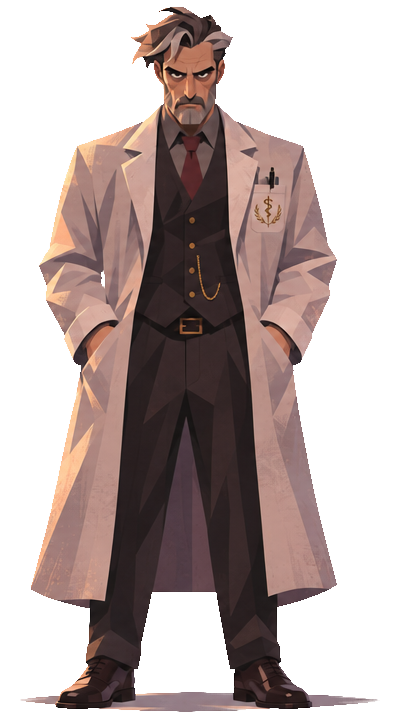
These zombies were idiots. No intelligence. No communication. Just empty, rotting husks. Dr. Patel claimed one of them communicated. Ridiculous. She’s too soft. Sees lost puppies everywhere.
How am I going to get around this? I need to ensure that doesn’t happen to me. I picked up the frame on my desk. It was a black-and-white photo of Dad. He was laughing with a scientist with dark hair called Carter. He had been Dad’s partner for the experiment. It’s the only photo I had of Dad laughing. He barely smiled with Mom and me. Carter was probably 6 feet underground, but I still felt a tinge of jealousy for this co-worker who seemed to have a better relationship with my Dad than we did.
Dad would’ve perfected it. Or at least Carter would have. If only they had known what they unleashed. I slumped down in my chair and turned to look at the whiteboard. Notes, diagrams, and chemical equations filled every available space. The real challenge was to work out what the other scientist had used in their chemical compound.
The war was a stupid thing. So many lives were lost, and the ones who had survived should have died as well. I wished every day of my childhood that my Dad had died. Then he would have been a war hero, and I would have been brought up by my mom. She could’ve remarried. Widows get sympathy and remarry quickly. Sometimes, stepdads would be horrible. But I think there was a slim chance they would have been worse than my own Dad. If there was even a small chance that I could have had a happier childhood, I would take it. Instead, there was just a dark cloud always. Why didn’t my mom just take me that day she left? I might have had a different life. Maybe do something else other than be a doctor. Or maybe I still would have been a doctor, but a happy one, like Patch Adams. I would have worked at a hospital, sorting out small kids’ UTIs and snotty noses.
When Dad was first diagnosed with Alzheimer’s, I think he had the same thought I had. Figure out the other compound. Become somewhat immortal. By then, we knew that they had survived. Dad had tried to find them. I asked him about it at the Fragile Care Center when I last visited him.
When they admitted him into long-term care, I had gone to his house to tidy up and pack his personal items. I knew he would never return to that house. There was no point in keeping it. I took what I needed and threw the rest up for auction. A folder had been on his desk that day, and the equations were on the board. Similar to the ones I have now on my own board. He had obviously been toying with it. But he was no scientist; he only knew about the rules of the army.
There were all these clippings in the folder as well, with articles about homeless people and drug addicts on the increase. He had a city map with crossed-out sections. He was searching for them. Trying to pin them down. One area had been circled, suggesting it was his next destination. Looking at all the clippings and the paperwork, it seems that everything he had done to that point suddenly came to a halt. He found them. But he didn’t capture them. Didn’t finish the work. Did he lose his nerve? Did he see something?
My Dad, the man of consequence and order, never chickened out. Something had happened that had caused him to change his mind. So what did he see that stopped him? Maybe it was the lack of intelligence. Maybe he had recognised his old fellow troop or something and got nostalgic. Maybe it was because they hadn’t aged, and he had. He saw his own mortality. Or perhaps their life, living on the streets, was worse than his.
I had a table in the centre of my room filled with vials, powders, and various liquids. I had managed to recreate the part that Dad had been involved in. Some of the chemicals had been hard to get hold of, so I spent most of my savings on them. The rest of my savings went into my own treatments to slow down my own death. None had worked, but it had slowed down the disease to get me to this point.
The relief I felt when I received those complaints about homeless people just standing around with glazed-over eyes was unbelievable. That morning, I had been suffering from particularly bad tremors. My muscles cried with pain from the inability to stop them. They were constantly strained and stiff. The stress of no hope was becoming unbearable. I had no direction. When I found Dad’s research, I knew it was the solution to all my problems. But then, there were all these question marks.
I had gone to the Fragile Care Center to talk to him about it. It had been a good day for him, but he couldn’t fill in the blanks. All he could say was, ‘Go find Carter.” That man in the photo. That man that my Dad had laughed with and had shared a part of his life with was more deeply and vulnerably than he did with his own family. But that man had died in the war. His body was probably long past the point of getting answers. They were probably buried in some mass grave or burnt like they had done back then.
Dad’s eyes glossed over then. I had asked him, “Did you see them, Dad? I found your map; you knew where they were.”
He had just closed his eyes, and when he opened them, I swear he had tears. He just repeated. “Go find Carter,” and then turned away from me. Dementia is a horrible disease.
All my life, that man had let me down. Often choosing the army over the family. No wonder Mom had left. She should have taken me with her, and I hated her for not. He had started drinking after the war. The yelling had been unbearable at the time when the two of them were together. After she left, the yelling at least stopped, as long as I stayed out of the way. But the drinking continued. He was either drinking or working. Those were his only two modes of operation. Not once did he stop to look at me and the type of home he had created for a small boy.
I now know that he had been red-flagged after that experiment. The army didn’t want him to get any more promotions or acknowledgements. They simply wanted to put him at a desk in the corner of a dark room and forget him. If they could fire him, they would have, but he still had friends who spoke kindly of him, so he stayed stagnant in a career that he once loved but only held resentment now.
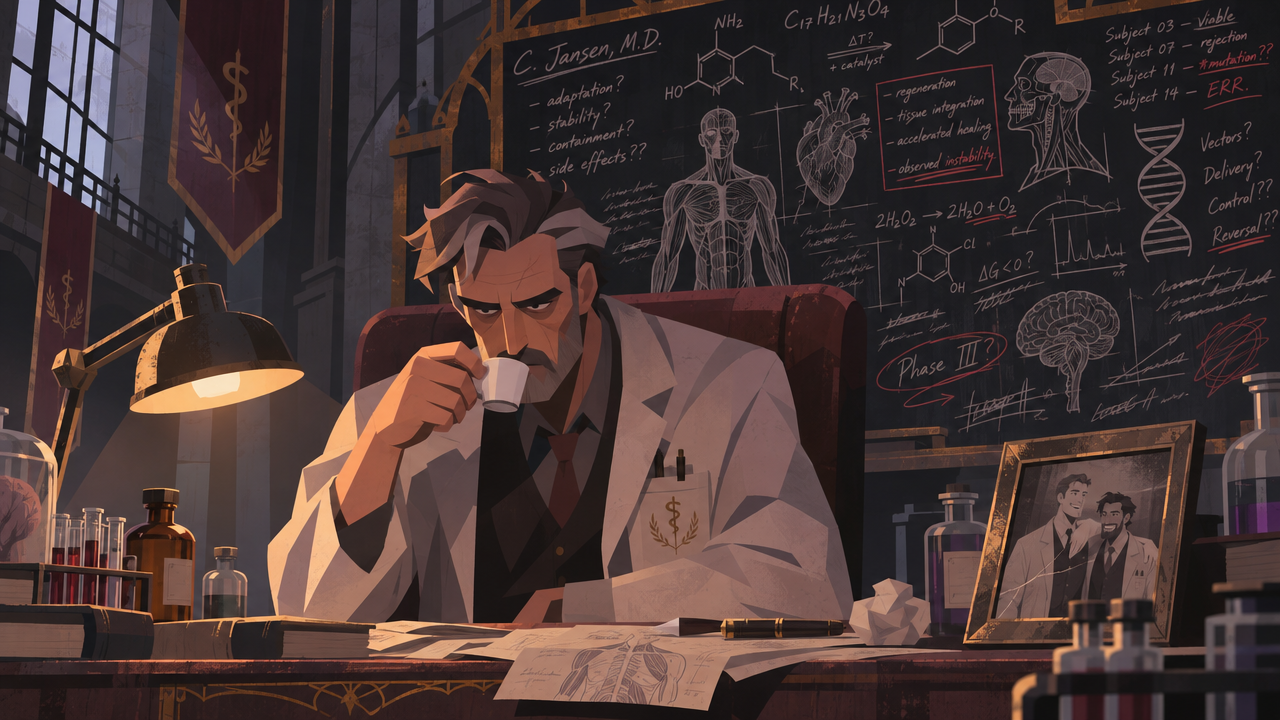
I guess that’s why I went into the medical field. Perhaps I thought as a child that as soon as I became an adult, I could find and fix someone just like him. Spare a child a childhood of pain and disappointment, as I had. Make that one difference. With all that heroism and idealism, it’s ironic the biggest difference I would make wouldn’t be for a random boy, but for myself. That I would ultimately pick up the last remnants of my father’s work and continue them. That his work could potentially save me.
The fluorescent light flickered, a slow, mocking echo of my own shaking hands. ALS. Progressive. Neurodegenerative. A slow death sentence. Especially for a doctor. My body is failing. Day by day. Piece by piece. Until I’m trapped inside a corpse. I reached into my pocket and popped open a bottle of Riluzole. This stuff wasn’t working as effectively as it used to. I was running out of time.
Dr. Patel should be getting those samples now. Should I go down and help her? I don’t want her to know how desperate I am. No one knows about my diagnosis. No one knows about my ultimate plan of converting over, of becoming one of them.
I opened the binder on my desk. Now that I had actually seen them up close, I had a few concerns. Their stunted awareness was definitely not ideal. There was no point in me abandoning my bodily function that is challenged by the ALS, only to become deficient in my cognitive function in my new post-mortem state.
There were other concerns as well. Their lack of healing. Does that mean that they slowly decomposed and that there was an ultimate end to their life cycle? Perhaps becoming a necrotic entity wasn’t the end or the solution to my problem. But it could still be the next phase, at least. There could be a minor solution to the restoration issue.
I switched my laptop on and leaned back in my chair. My coffee was too cold. The laptop hummed slowly as it warmed up. I should take this time to warm my coffee as well. I turned on the small coffee machine and opened the drawer to fish out a capsule. The dark roast is what I was going to need. The rich and caramel flavours, with the bitter undertone, were exactly what this situation required. A simple but effective dopamine increase created by the joy of caffeine.
The machine purred softly, pushing hot water through the punctured capsule and releasing a stream of dark, aromatic liquid into my cup. It finished with the classic crema on top. Small bubbles of emulsified oils and carbon dioxide. The telltale sign of a well-pulled espresso. My student part-time job as a barista gave me the knowledge to make me feel like I was a coffee connoisseur. Once a barista, always a barista.
The computer was asking me for my login information. I could feel my frustration levels bubble at the back of my brain. The small cup of heated bean water would hold it back for now. I sighed as I sat down and started typing.
The experiments were going to start tomorrow. Dr. Patel should bring the samples to the lab shortly, and we can start with that. But I want to know more about how these undead creatures operate. I overheard one of the security guards refer to them as “zombies.” Not an entirely inaccurate description. They were, after all, the dead, awake.
I wanted to push their mortality and see if there was a, shall we say, post-post-mortem with them. The best way would be to do an acceleration test. Chemicals or environmental factors, such as radiation and heat, can be applied to accelerate the decomposition. This could cause extreme discomfort and visible damage, especially if it causes extensive brittleness or tissue breakdown. There was also the neurological factor. Scanning, such as an MRI or EEG scan, would help to observe brain function. Perhaps we should try doing stimuli tests with lights and sounds to see if and how their brains react.
There is also a lot of curiosity about whether they are actually dead. I might ask Dr. Patel to do a gas and chemical exposure to try and see if they cough and die again. Then, electrical currents are applied, and even cold and heat pressure. These tests would be inhumane if conducted on a living species, but since they were proclaimed dead a long time ago, I doubt the World Health Organisation would have an issue with it.
I looked at the small white cup filled with dark brown liquid. Do the bio-posthumous subjects require substance? We hadn’t brought them anything since their arrival, and they hadn’t requested anything. If I was going to die and resurrect myself as one of them, which I had every intention of doing, did that mean this was potentially one of the last cups of coffee I would have? I had the urge to gulp it down and quickly make another cup, but the caffeine would bring an onset of a headache that would worsen my mood, not lift it. But perhaps I should make a list of meals or something before I finish this journey.
I thought about what Dr. Patel had said about ZO-03. According to her, his name was Nee. When she told me that, I have to admit, I got excited. But when I went in, he just stared at me with those dead, dull blue eyes… No. If I remember correctly, Dr. Patel’s last sexual partner had strawberry-blonde hair, similar to our subject. I think perhaps she was being soft. I will need to keep an eye on that.
I admit that when I hired Dr. Patel, I imagined she’d soften toward me. A third wife wouldn’t be so bad. Something warm. Something comforting. But since the diagnosis, the last thing I need is a distraction. Someone who might disagree for some stupid moral reason that was invalid. It was good that Dr. Patel had never shown me a kind smile. Even though I could picture her black hair splayed across my pillow. I could almost smell it—coconut and pomegranate, mixed with the faintest trace of body butter.
No. She’d be a distraction. But would distractions even matter once I crossed over? The female subjects that we had brought in were far from appealing. Their skin was taut and dry. One of them had a considerable chunk of chest missing, with organs and dry muscle exposed. If the subjects had physical needs, I doubt they would have been attracted to each other. Could they be attracted to us? Surely not.
I wondered if I should watch the security between Dr. Patel and this ‘Nee’ zombie to check. They wouldn’t have flirted, would they? Obviously, if she was telling the truth, then something had happened that I didn’t experience. The nurses all said the subjects were docile, too, when they washed them. They didn’t get in any chit-chat at all. And yet, when we captured them, they had been incredibly active. One of them had even been able to drive that bulldozer. It was a pretty strategic move to block security like that. Maybe they just played dumb. How am I going to know for sure?
All these little human worries. Soon, none of it will matter. I took a long, deep gulp of my coffee. Coffee I will miss. Dr. Patel, I could forget. I might forget a lot of things. Would Dad notice if I was gone? He was the only one who really knew I was alive, to start off with. The staff wouldn’t care. Neither would my superiors. They would simply hire a new doctor to run this place.
The truth is, my life isn’t that far off from being a zombie’s existence. Soon, my body will match the reality.





Leave a Reply