
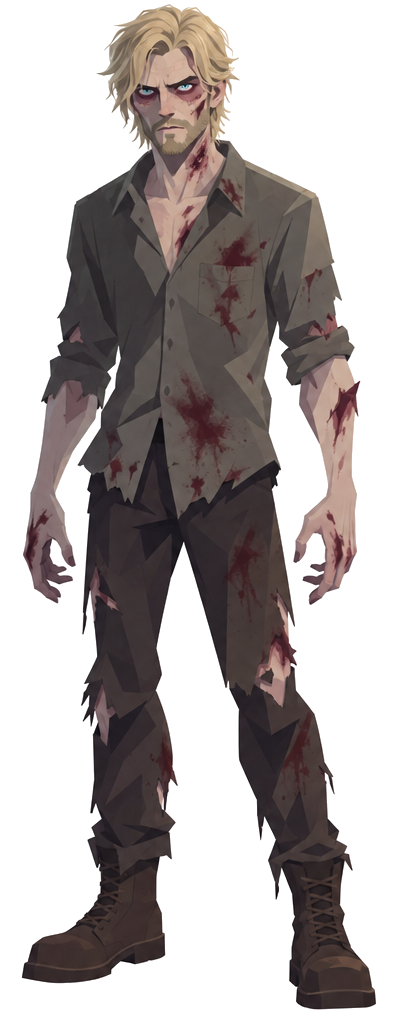
I guess I’m a zombie. I’m not entirely sure. It’s not like I was seated by close family and friends and told in a gentle fashion. It’s something we’ve kind of worked out. I mean, we have no pulse. We don’t breathe. We barely operate. And yet we are alive. In a sense.
There are, of course, other options that we thought of, like maybe we were vampires. But the lack of fangs and bloodthirst made us scratch that off the list. We could be some type of monster that a doctor conjured up in their lab. But then… where’s the doctor? There also wouldn’t be so many of us.
You see, there was this war. Chemicals were used. So were nukes. There are now sections of the world where no one goes. And we died. A lot of people died. But then. Then we woke up. Not all of us. Just some of us. And the people that never died didn’t know. They were still fighting the war, dealing with economic declines, tending the wounded, and helping those who were traumatised, people who had lost their families.
Looking back, it had to be chemical. A compound. Maybe a mix of them, coming in from different sides of the fight. I remember gas was everywhere. We had gas, and so did the others we were fighting. After that, we dropped dead. Then, when everything was quiet, we started to move again. Walking past others that still remained dead.
A few of the humans on the battlefield saw us. They screamed. We panicked and killed them. I guess killing the living is something that is inherent in being a zombie. But we didn’t mean to. We didn’t eat their brains—that would be gross.
After a while, the world went quiet. The bombs stopped. The buildings were rebuilt. Some zones that got blasted with nukes were quarantined off. But most places were slowly put back together. People hiding in bunkers came out. People in the army quit and returned to their jobs on Wall Street. It took a few decades.
And us? Well. The good thing about any War is that a lot of people end up on the streets afterwards. They’ve lost their homes and their savings. Some people can’t go back to ‘regular life.’ The images of pain and death have been etched on the back of their eyelids, waiting for them to close their eyes. The only way to stop the anxiety is to become dull. Or to escape. Books and movies provide escape for most people, but not for those who have truly known terror. They need something more substantial.
Society can’t deal with those who are barely surviving. They ignore them and pretend not to see them, even though they are right there, slumped against the wall, begging for help. In fact, begging increases the camouflage.
It is there that we hid. In plain sight. With dirty clothes and unwashed skin. Our groans are assumed to be drug-induced when really it is our slow decomposition.
I’m Nee. Hi. I think Nee used to be Neil. Or Nick. Maybe Nelson? It’s long gone now. When I first woke up, I remembered a lot more. But over time, it faded. The only thing I do have is a pocket watch. I had it with me when I woke up. The armour uniform has long since worn through and been replaced by various clothes I pick up at the homeless shelter now and then, but the watch I kept. We all kept something from then.
The pocket watch is stuck at 10 am. I often wonder about the significance of that. Was that the time I died? Or was it just the time the pocket watch died? Perhaps we died together. I like to think it’s the latter. No one really wants to die alone, and if the only thing that was with me was the pocket watch, it is comforting. I didn’t die alone; I died with a pocket watch. It’s more than a lot of other people can say.
I wish there was some sort of engraving or indication as to who gave me the watch. Maybe I bought it for myself for an achievement I did. Or perhaps it was handed down to me by a family member. A loving dad? A grandpa who told wonderful stories and smoked a pipe on Sundays. Family must be a nice thing.
The watch has some scratches and other nicks, but otherwise, it’s in pretty good condition. I could probably pawn it if I needed money. But when you don’t sleep and never eat, you don’t need money. I also have very little concern about my looks. I mean, I’m dead. Ageing isn’t such a problem anymore.
But decaying is.
Yeah, you didn’t think about that, did you? It’s OK. Few people do. The truth is that zombies are not immortal. We are slowly decaying. Our bodies can’t last forever. Every time we break a bone or get a scratch, that’s another area of our body that won’t heal. We can’t heal. The gash is basically a tear in our skin that will forever be there. There are no living cells to fix it.
Bet you didn’t think about that, did you? Don’t worry—neither did we at first.
You’ll be surprised at the amount of care a zombie has to have with our own personal being. We even have an underground care centre in the shadows of the bridge near the docks on Hertzog Blvd. It’s run by two women called Taa and Eve and one guy called Daa. I think Taa was actually a practitioner in medical care before. Her personal item is a small caduceus pin that she has on her collar.
The medical zombies keep useful things for zombie healthcare, like duct tape, steel rods, staple guns, and super glue. They call themselves the ‘Rot and Repair Shop.’ We have odd humour like that. It keeps us smiling.
The Rot and Repair Shop isn’t much to look at, tucked under the bridge where the air smells faintly of rust, damp concrete, and something sour. A single flickering bulb sways above, casting jittery, skeletal shadows. It feels like a cross between an abandoned garage and a junkyard. Shelves line the walls, packed with everything from duct tape to bolts, splints, and oddities that might have been scavenged from an old hospital or hardware shop. In the corner, there’s a rusted-out chair—’ the surgery station,’ Daa calls it, though no one would sit there voluntarily.
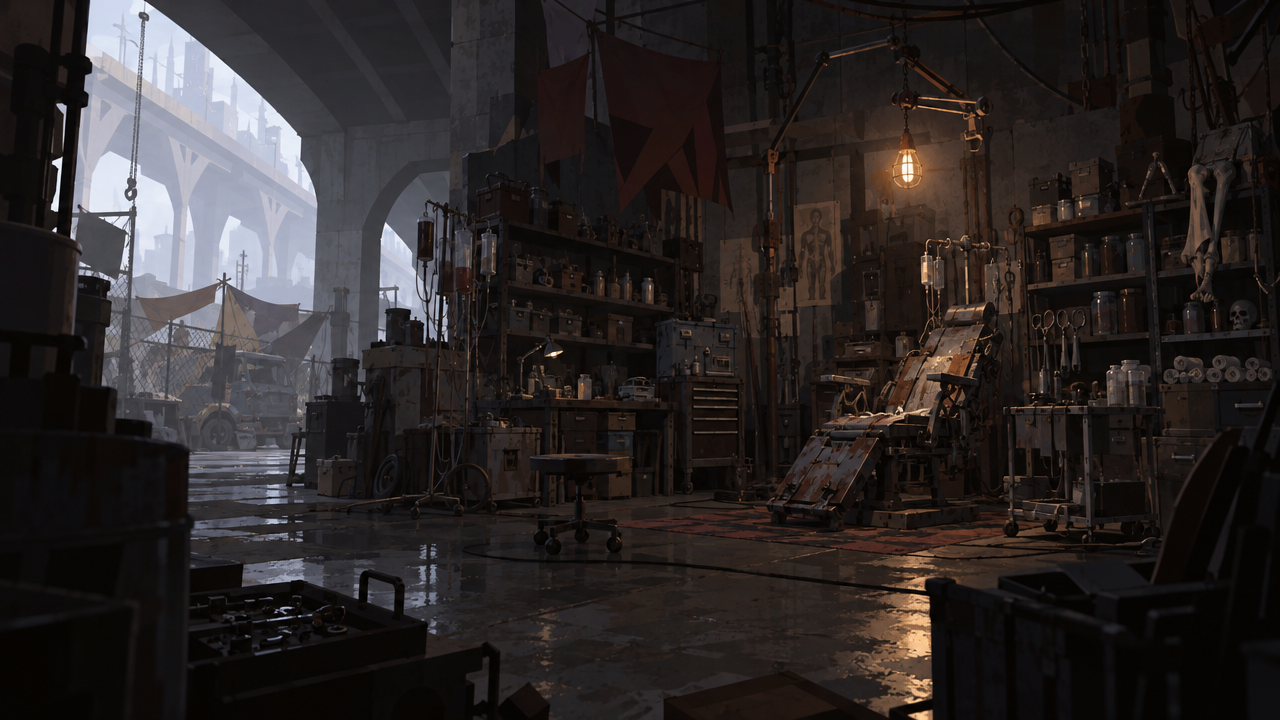
Taa, with her caduceus pin glinting faintly, stands behind a table cluttered with glue and gauze. Her hands move fast and sure, even when her own fingers look like they might fall off. Eve’s the quiet one, organising supplies with a precision that suggested she once ran a tight ship. She often disappears for a few days on a supply run, fetching and finding items that could be useful. She used to just find items on the floor, next to the shop, but now she has to travel far to get anything decent.
Daa, on the other hand, is always tinkering with something in the back, muttering about how a spring-loaded splint will be ‘the next big thing.’ The place is a mess, but it’s ours. And somehow, it works. All of us try to help out, and we often bring in things that might be useful if we find anything.
It’s a balancing act to be a Zombie. If we move too much, we risk injury. If we move too little, we look suspicious to humans. We also start to seize up a bit like something cruel. You think you get stiff sleeping with your neck funny? Try rigor mortis—that’s absolute stiffness.
Every now and then, it gets too much, and we can’t repair it, even with the best patch kits or Velcro straps. Our time is done. We call it the Drift. A lot of us are petrified of it. You live so long that death becomes even more daunting. There is also so much uncertainty about it because what if there isn’t anything for us? I mean, do Zombies have a soul?
Some of us have thought that maybe that’s all we do have. Our souls keep us animated after our body has died. But then, does our soul know how to ‘move on’ after we Drift? Or does it ‘Drift’ with us into oblivion? “What if there isn’t anything waiting for us on the other side? What if the Drift is all there is, and we fade into nothingness?”
We have a little ceremony for those who are about to ‘Drift.’ We hope we still have a soul and that perhaps doing a ceremony will guide it to where it needs to go. We place their object in their hand. We share words. Sometimes even a line or two of a story. We put them on soft ground. Often by a construction site where the ground has been tossed and turned. We kind of sit in a circle around the Drifting Zombie and hum. It’s a groaning, haunting, mournful song we make. There is no melody, just a vibe.
There is a soft, gentle sound that usually comes from the Drifting Zombie. It’s a distinct noise that we know so well. It sounds like the scratch of a mouse against wood. A few leaves being trodden on. A scrunch of newspaper squeezed into a ball. Then a little movement ripples through. The body jerks a little once or twice and turns into dust. The personal object is all that is left. We push it further into the dust so that it is hidden. And then we leave.
We might not know what is beyond our state of being. But it is nice to not be alone when it happens. Kaa thinks I’m a bit silly for being an idealist. I mean, look, we are zombies, so we don’t say things in so many words when we converse.
In fact, our communication is actually a fascinating thing. We’ve managed to strip away whole syllables and really grind words down to their most straightforward sound, and yet we know what the other is saying. The adjectives and adverbs are lost, pushed into the word itself through the volume or the tone. Our intensity levels have become part of our dialogue. It’s about the feeling of the sounds we make. Peeling back sentences to the minimal spine required for understanding, and yet, it is somehow more emotional and expressive than the original articulation.
A language expert, like a linguist, would have a field day watching Kaa and me. We would let them too, but then he would, at some point, probably want to smash our heads in with a bat and shout “Zombie!! Zombie!!” Humans are so uncivilised sometimes.
Kaa is the closest thing I have to a best friend since we woke up. We think we may have been friends before. We woke up not too far from one another, and we looked a bit familiar to each other. Or perhaps we killed each other. Maybe we were from different countries, at war with one another with decades of hatred for each other. Then, we were flung together at one crucial point in time, only to be frozen in that one unlikely moment when we were together. The chemical wash or nuclear blast altered our DNA so that for the rest of our decay, we would be friends.
Isn’t life weird?
Of course, this is all speculation. I could have been running to give Kaa water, for all we know, at our death. Or a letter maybe. I could have been bringing him a letter from his wife telling him she had found another and would not be home when he returned. The scenarios are endless.
Kaa doesn’t move like the rest of us. Most zombies shuffle or limp, their joints grinding with every step, but Kaa is different. He’s deliberate. His steps are slow but steady, his back always straight, like he’s daring the world to notice him. His military training obviously runs deep into his psyche, and followed him when he crossed over.
He’s taller than me, with dark, stringy hair that clings to his scalp like seaweed. One of his eyes has gone cloudy, but the other burns bright, scanning the world with sharp, restless focus.
Kaa isn’t interested in my stories or possible truths. He is constantly worried about humans. With each year, there are more of them about. They are repopulating and expanding into the city’s darkest corners to bring light into them again as they reclaim their concrete jungle.
They see us, but they ignore us. They don’t know what we are, assuming we are the dregs of society. Leftover bits and pieces from the war or family members who have been disgraced. That’s not to say those humans aren’t around us. They are. But they even assume we are the same as them. Well, most of them anyway.
Crazy Mike knows what we are. He’s been around us long enough to notice that we haven’t changed. We just get more duct tape plastered on us. He keeps trying to tell the other humans that we are zombies. That we are all planning on eating him, so he refuses to sleep. The social care workers and volunteers who check on us talk gently to him to try to calm him down.
Sometimes, they glance at one of us quickly because some part of their brain wants to check that Crazy Mike isn’t telling the truth. Their instinct knows that there is something a little odd about us. But we just slowly move on. Zombies aren’t supposed to do that. They are supposed to eat your brains. And so we disappear into the grey zone of the non-threatening, but embarrassing category of humans.
But Kaa doesn’t think we will be able to stay here for long. We need to come up with a plan before a different war happens between us and them.
The flap of the Rot and Repair shop opened, and Rune came out.
“Facelift?” I groaned.
She made a sort of shuffling noise that was close to a laugh that any zombie was going to get.
“Don’t think I need one of those,” she moaned. “My looks seem pretty well preserved. It’s actually just my foot. Taa has re-duct-taped it. Think I crushed some of the bones at some point. But who knows when.”
I nodded knowingly. Time has a weird feel to it when you’ve been around the place for long. Taa then came out.
“We need some more supplies,” she muttered, looking at me. “Are you and Kaa going out to the humans any time soon?”
I nodded.
“What are you all plotting?!” came a shout back from a tent nearby. Crazy Mike. “I know what you are!” he shouted.
We looked at each other and then him.
“You can’t get me. I got my protection on!” he said, waving about a garland of garlic. I was pretty sure garlic was for vampires, not for zombies, but I wasn’t going to correct him. I looked at Taa and Rune and snorted a dry laugh. They looked at me, confused. I let out a long moan and lifted my arms up. Then I stiffly walked towards Crazy Mike.
He shrieked like a pork belly pig, then disappeared inside his tent. The garland was casually thrown out of the tent before the zip shot up. Taa and Rune started to giggle as best they could with their dry, hoarse bodies.
Kaa thinks we won’t be able to stay here much longer. That soon, the humans will notice us. That something will snap, and we’ll be hunted. He might be right. But tonight, we patch ourselves up. We laugh, if we still can. And we wait.


Leave a Reply