
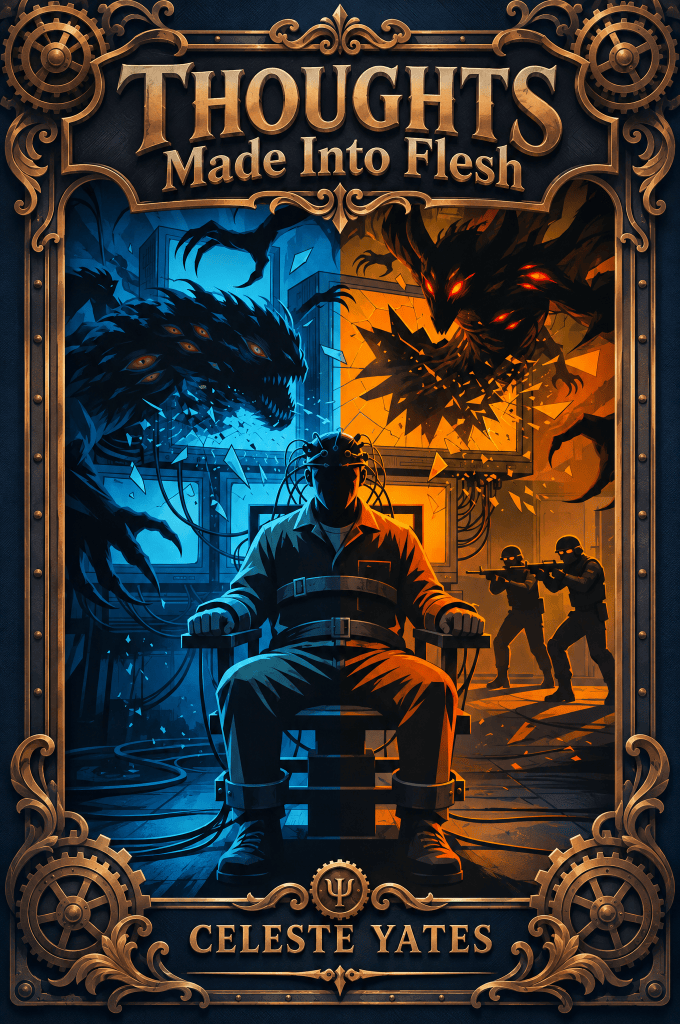
This is from an ongoing web series, called Thoughts into Flesh. Start from Chapter One, or if you know the story, carry on reading below.
The air was dry from the air conditioner. It was at a low temperature, set precisely to an optimized figure. Research had shown that if the temperature was the same as body heat, employees were comfortable. Comfortable resulted in average results. Slightly warm, and the body would want to slow down and production dropped. If it was two or three degrees too cold, it naturally kept the mind awake. From a survival perspective, this temperature would mean that a person needs to find shelter or make a fire. Be proactive. Of course, they were already in shelter. The mind could override the instruction, but the adrenaline would stay. The drawback of keeping the body on ‘alert’ the whole day did mean that the human was tired when they left work.
Which was good for the company. Tired humans meant that they would go home, shove food in their mouth and binge-watch shows with adverts, making networks rich. They would fake the hormones from real connections with the scripted ones on the screen. Because they weren’t being social, bedtimes would be reasonable, resulting in them waking up at the correct time for work. Lack of social activity also meant lower alcohol intake, resulting in higher cognitive function.
There was little noise outside of the air-con. If you were paying attention, which most were not, you could hear the noise of the data centers from down in the bottom floors. Occasionally, someone would reach to the back of their neck, pull out the small circuit, place it on the designated charging station on the desk, and go for a timed bathroom break. Short breaks were allowed, at staggered times, so that social gatherings were avoided. Employees had the option of choosing three staggered short breaks, or one long one, as per the human rights policy. They were required to be in the office from exactly 07:45 to 16:45, which included their obligation to the company for eight hours, plus the one-hour mandatory break.
Studies found that a time that was uneven resulted in happier employees, as they felt like they were getting off ‘early’ and closer to 16:00, when actually, the time was closer to 17:00, and they were still working the full eight hours, because their day started 15 minutes earlier. But research showed that most didn’t realize.
Desks contained a single monitor, with a computer built in. There was no need for keyboards or a mouse. There was no need for paper, folders, pens, pencils, or sticky notes. The stationery budget had been completely removed, reduced, and now was allocated for monitor dust and smudge cleaner and a microfiber cloth. To save costs on cleaners, employees were required to wipe down the screen and table before the shift. The curved MDF table, with glossy white plastic vinyl wrap, contained a small drawer that contained the bottle and cloth. The drawer was seamless with the table and had no handle. You had to push it to spring it out. Otherwise, no single item was on the table.
As no personal work or activities were allowed, other than the work at hand, corporate didn’t see the point of cubicles, as privacy wasn’t needed. They boasted about a ‘transparency’ approach, which applied more to their employees than their business ethics.
All work was done, mentally, between AI and a person’s thoughts. It was simple, required little physical effort, other than sitting with your hands in your lap, motionless. Yet, researchers showed that burnout was pretty high at the low age of 27.
On this particular day, Fred found the humming louder than usual. For some reason, it bothered him more, as if he was the only one whose brain couldn’t shut it off. He didn’t want to say anything about it. It was best not to be different. People who were different disappeared pretty quickly. They were unemployable, as they weren’t allowed to use the technology that so many companies had adopted. Their careers would be stunted, and there would be no path for them. It was advised to guide your children to safer career choices that were guaranteed a job.
Fred shifted in his chair. The AI was going through a mix of calculations, and his attention, in this unusual moment, wasn’t needed. His foot slipped on the vinyl floor and knocked his bag, exposing his lunch box of an uninspired ham and cheese sandwich with the daily requirement of fruit or fruit supplements. Obviously, their lifestyle was such that many people also needed other supplements and monthly injections to compensate for the lack of nutrition in the food and the lack of sunlight.
Fred fidgeted with the corner under his table. He knew it: to create these white monstrosities, they basically made the table from the chip MDF, then vacuum-pressed the plastic film over it, so that it was seamless. But because of the cheap glue and efficiency or corner cutting, Fred was able to stick his nail under the one corner where the drawer was. It was the one weak area of the entire table. And he could pull at the plastic wrap. It wasn’t built to be defined, and so once he had a firm grip, it disintegrated pretty easily.
There was a click, click, click noise, and Fred immediately straightened his back and kept still. He held his breath and looked forward to the monitor. He knew what the noise was, and he knew it well. It was the shoes of Erica Bickly. Erica worked contract and didn’t sit at a desk. She had been assessed, and corporate had come to the conclusion that while she wasn’t what Fred called a ‘desk drone,’ she was still incredibly useful to the company, as what she did wasn’t creative. It was precisely aligned with company policy.
He envied her. Her special skills were one of the few that had been deemed worthy enough to be interesting work. She was allowed to follow her passion without any negative consequence. As a result, she strove to do her work to the highest degree of quality. What Fred didn’t know was that when she worked down the corridor to the offices, and she passed all of them, in their white buttoned shirts and navy skirts and pants, she was terrified of all of them. She was terrified that if she didn’t perform well, they would put her in an ergonomic chair and forget about her. Just like they had forgotten about all these poor souls who poured their intellect into a computerized box, to get money that, in theory, has no value outside the constraints of human society. In fact, since everything became ‘cashless’ an age ago, money didn’t even have any tangible quality now either. It was only a neon green number on a screen that somehow got tangled up in everyone’s self-worth and survival.
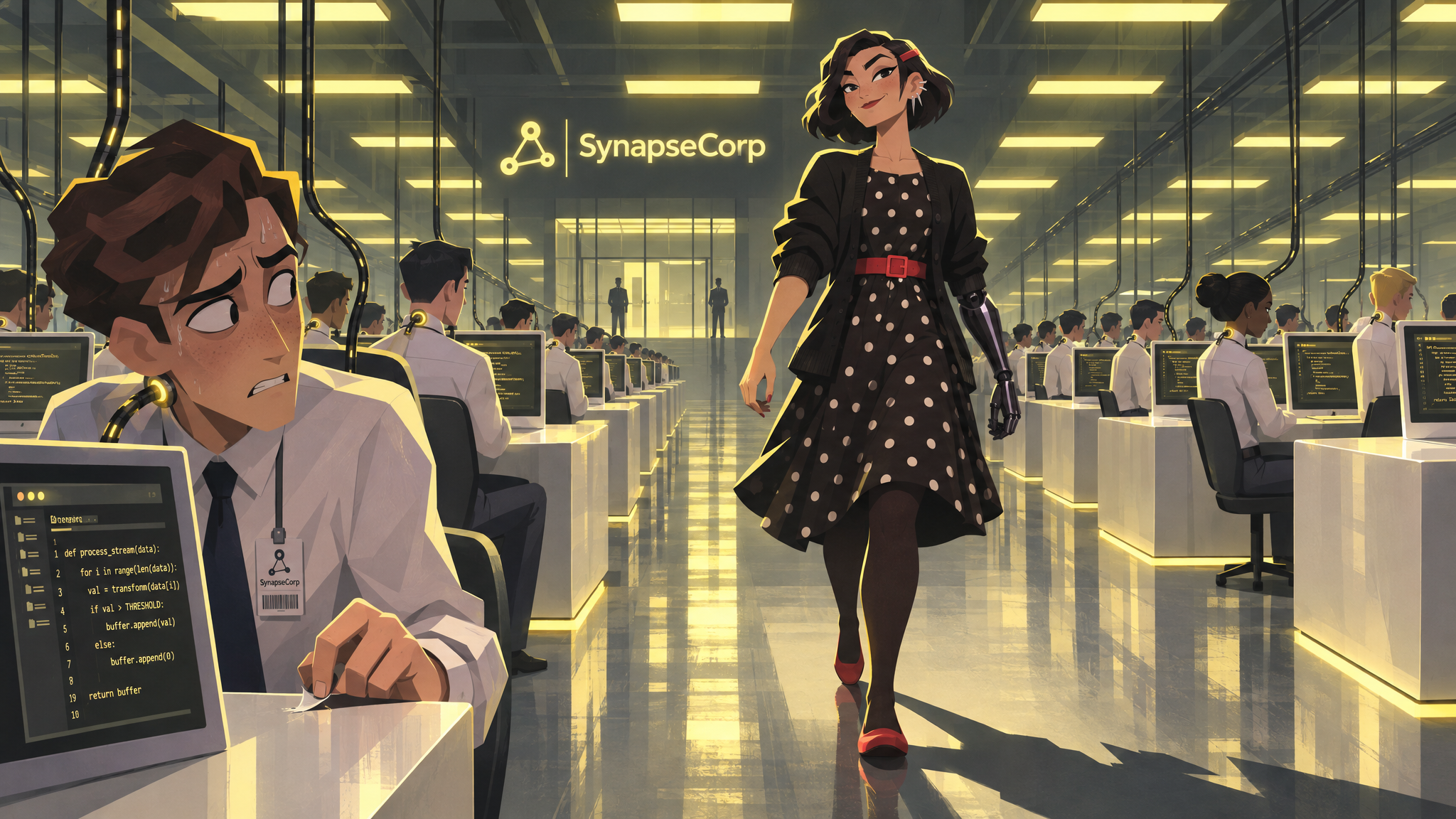
Fred looked at Erica in the corner of his eye. Her red pumps were comfortable, as she had to be on her feet all day. Her black leggings matched the black fabric of her white polka-dot dress, and then her red belt balanced with her shoes, which balanced with the red hair clip. The black blazer lifted the otherwise casual outfit to one that could easily fit in a boardroom. The clothes were chosen to appear non-threatening. To make her innocent and seem sweet. But the fact that she was able to move swiftly in them was an indication of her work. And no amount of pleats in her dress would soften the glisten of her bionic arm – another tool of her trade, to ensure that she was the best.
Fred watched her move, swiftly and gracefully between the desks. As she neared the end, she stopped. Her body still faced the front, but with pure muscle isolation, she was able to curve her head to the left. Her eyes moved to look at Fred. Fred immediately straightened his eyes back to the screen and hoped that she didn’t come close to him. She stayed calm and rigid in the pose, looking directly in Fred’s direction for a few moments, before she turned her eyes and head back to the front and continued her walk towards the offices of Bill and Jason, the CEOs of SynapseCorp.
Before you go – drop a like so I know you were here!








Leave a Reply